Gustav Klimt:
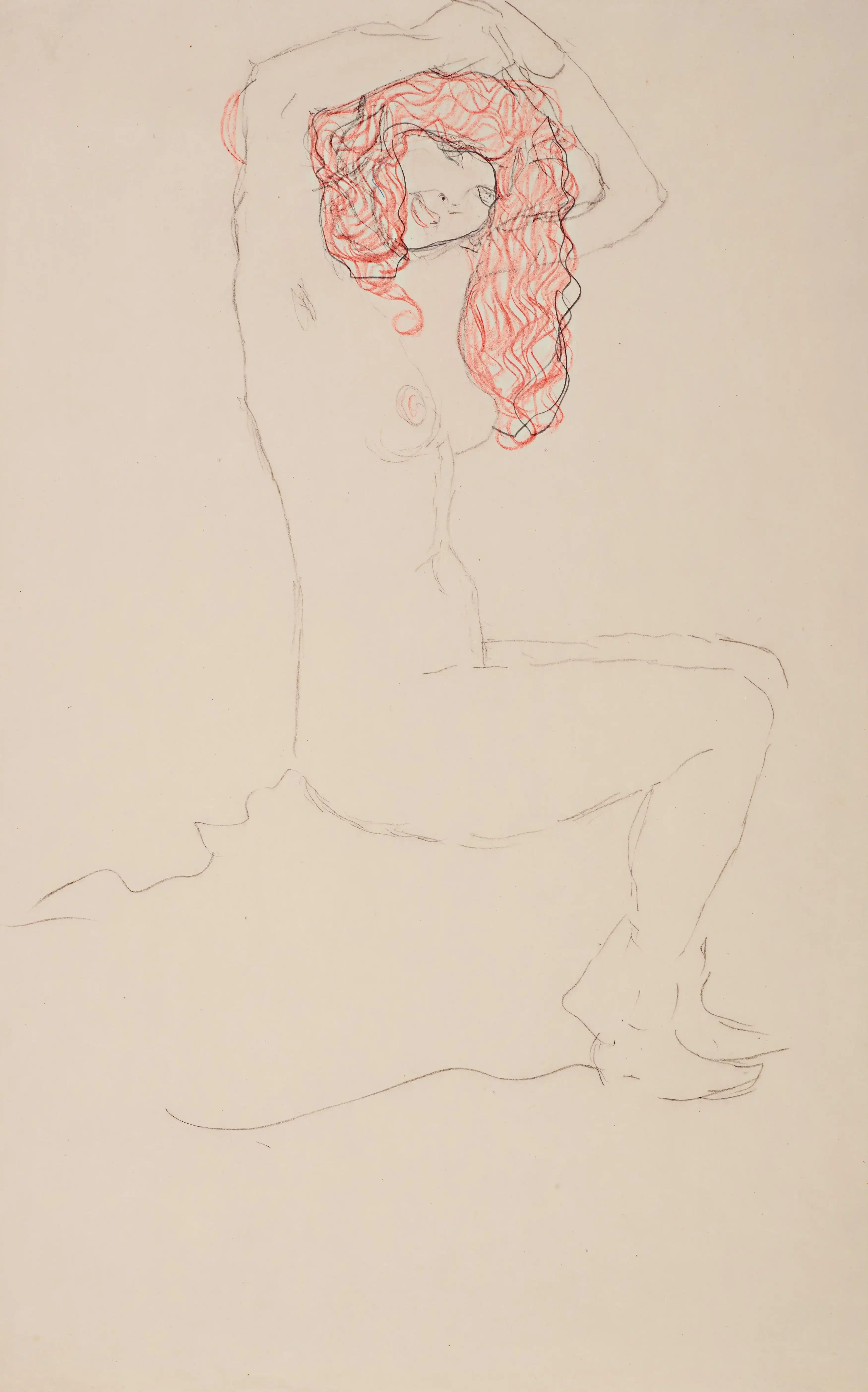
Seated Female Nude with Red Hair, Her Arms Crossed Above Her Head (Sitzender weiblicher Akt mit rotem Haar, die Arme über dem Kopf gekreuzt), c. 1907
Pencil, black chalk, red and blue crayon on Japanese paper
55.2 × 35 cm
© Leopold Museum, Vienna
(Strobl s1631)
This drawing belongs to the moment around 1907 when Klimt’s studies of the female nude become increasingly exploratory, intimate, and rhythmically composed. The young woman sits with her arms lifted and crossed above her head, a pose that elongates the torso and opens the line of the body without any sense of strain. Her red hair, rendered with a few vivid strokes, forms a warm counterpoint to the cool, pale surface of the Japanese paper, giving the figure a quiet radiance.
Klimt’s handling of materials is exceptionally sensitive here. Pencil and black chalk establish the essential structure of the pose, while the red and blue crayons introduce a subtle chromatic vibration that animates the surface. The Japanese paper, with its fine, absorbent texture, allows these pigments to settle softly, lending the sheet a luminous delicacy characteristic of Klimt’s most refined nude studies. Nothing is overstated; the drawing feels like a moment of unguarded presence, held with remarkable tenderness.
Alice Strobl, in her note for the Leopold Museum, grouped this sheet with a series of “Nudes and Semi‑Nudes in Various Poses” from around 1907, and her observations illuminate several of the drawing’s most striking features. As she points out, Klimt used red crayon here only for the model’s hair, with faint touches at the lips and chest. This selective use of color gives the hair an unusual prominence, standing in deliberate contrast to the rest of the figure, whose contours are merely suggested in pencil. Klimt then reinforced the hair — and the eyes — with stronger pencil lines laid over the red crayon, heightening their presence even further. Strobl also notes that this vivid hair motif appears in a related drawing now in the Wien Museum, depicting a kneeling nude who looks out with the same broad, direct smile; it is likely that both sheets depict the same model.
The pose itself is one Klimt returned to frequently in these years — a seated nude whose lifted arms create a natural arc through the body, emphasizing both vulnerability and composure. This model belongs to the group of young women who populate Klimt’s studio drawings around 1906–08: self‑contained, inwardly focused figures whose quiet confidence he captured with a mixture of precision and empathy. The red hair, indicated with just enough detail to anchor the likeness, adds a note of individuality without turning the study into a portrait.
Klimt’s use of red and blue crayon is especially telling. The red warms the contours of the body, tracing the softness of the torso and the curve of the hip, while the blue reinforces areas of shadow and gives depth to the lifted arms. This interplay of warm and cool tones is a hallmark of Klimt’s draftsmanship in this period and appears in several related studies, where he used color sparingly but with great expressive effect. Here, it heightens the sense of nearness — the feeling that the viewer is witnessing a quiet, unposed moment in the studio.
What gives the drawing its particular strength is the balance between clarity and intimacy. The figure is fully present, yet nothing feels exposed for its own sake. Klimt’s line is attentive rather than insistent, tracing the body with a softness that respects the sitter’s inwardness. In this, the sheet reflects the broader shift in Klimt’s nude studies around 1907, when he moved toward a more atmospheric, psychologically nuanced understanding of the female figure — less concerned with idealization than with the quiet truth of a body at rest.
Seated Female Nude with Red Hair, Her Arms Crossed Above Her Head stands as a testament to Klimt’s ability to evoke both structure and emotion with the most economical means. With a few strokes of pencil, chalk, and crayon on a luminous sheet of Japanese paper, he captures not only the form of the model before him, but the gentle, unspoken atmosphere that surrounds her — a moment of stillness held with extraordinary grace.

Leave a Reply