Egon Schiele
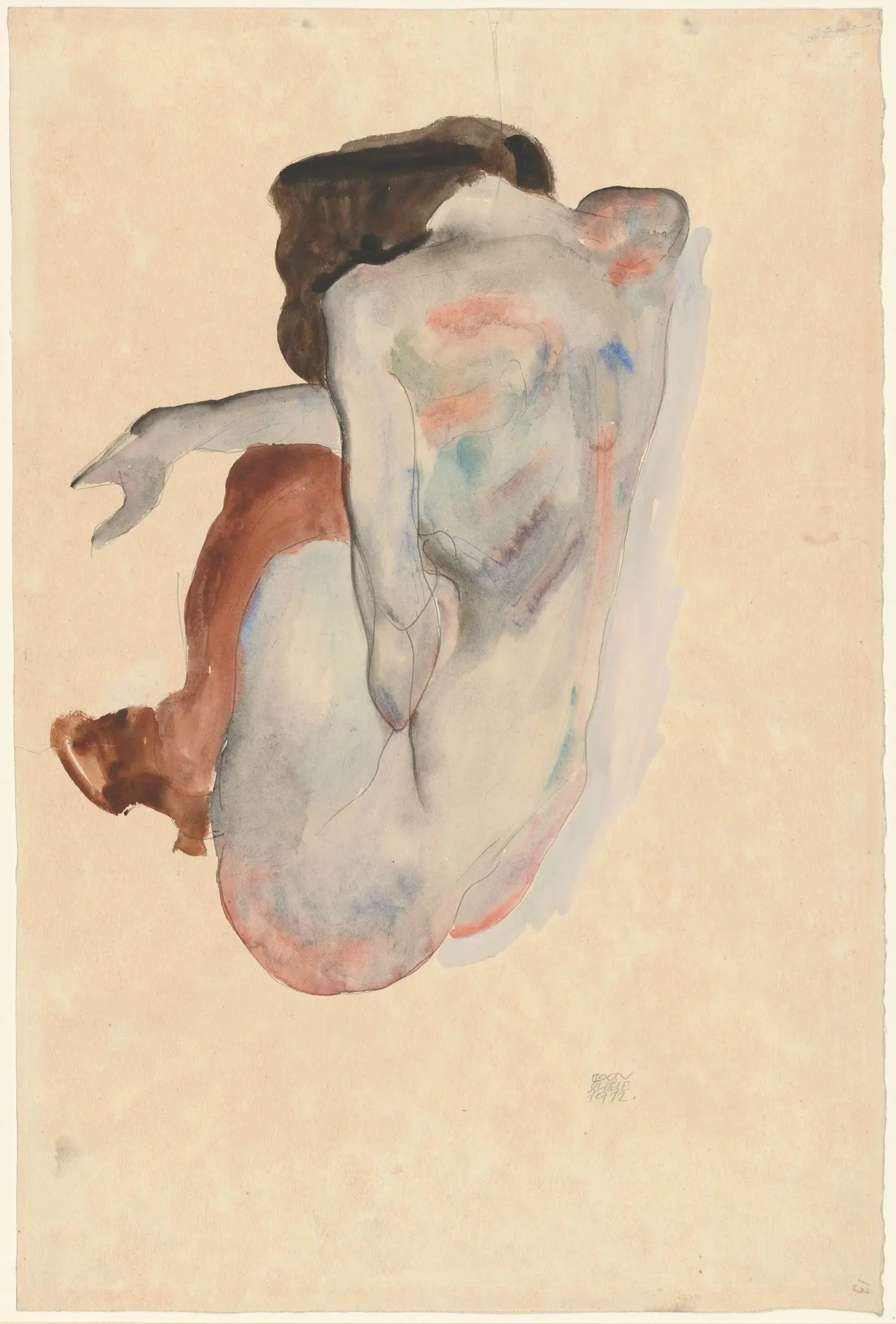
Crouching Nude in Shoes and Black Stockings, Back View (1912) (Kauernder Akt mit Schuhen und schwarzen Strümpfen, Rückenansicht)
Watercolor, gouache and graphite on paper
48.3 × 32.4 cm (19 × 12 3/4 in.)
©The Metropolitan Museum of Art, New York
(Kallir d1058)
She crouches, not in collapse but in containment. The pose is compact, almost architectural—knees drawn in, spine arched, head turned away. There’s no invitation here, no gesture toward the viewer. Her body is held, not offered. The shoes—polished, formal—seem almost absurd against the rawness of her posture, while the stockings bracket her legs like punctuation marks in a sentence she refuses to finish.
Schiele’s line is spare but insistent. It doesn’t caress; it delineates. The graphite outlines are taut, almost surgical, yet the watercolor softens the flesh, bleeding warmth into the paper where the gouache holds fast. The tension between media mirrors the tension within the figure herself—between exposure and withdrawal, between being seen and remaining sovereign.
This is not a nude in the classical sense. It resists that lineage. There is no languor, no softness, no myth. Instead, there is a woman in a moment of private suspension—neither erotic nor passive, but alert, inward, and unyielding. Her turned head is not modesty; it is refusal. Her crouch is not submission; it is self-possession.
1912 was a crucible for Schiele. Legal scrutiny, emotional upheaval, and a deepening of his graphic vocabulary marked the year. This drawing—Crouching Nude in Shoes and Black Stockings, Back View, catalogued as Kallir d1058—belongs to that charged moment. It carries the imprint of confinement—both literal and psychological. The model is not named, but her presence is unmistakable: she is not muse, not object, but participant in a quiet act of resistance.
The black stockings, often fetishized in visual culture, here serve a different function. They anchor her, hold her in place, mark the boundary between intimacy and performance. They are not adornment but armor. The shoes, too, suggest a threshold—perhaps she has just arrived, or is about to leave. We catch her in the interval.
There is tenderness here, but it is not sentimental. It is the tenderness of attention, of precision, of a gaze that does not flinch. Schiele does not beautify; he witnesses. And in that witnessing, something rare emerges: a moment of unguarded interiority, held in line and stain.
Leave a Reply